
Far afield
Like many Huisman yachts, Twizzle works pretty hard and travels quite a distance for her owner. But when she isn’t enjoying herself racing around the rocks of the Caribbean, where does she go to take it easy?
Answer: Thailand and Myanmar
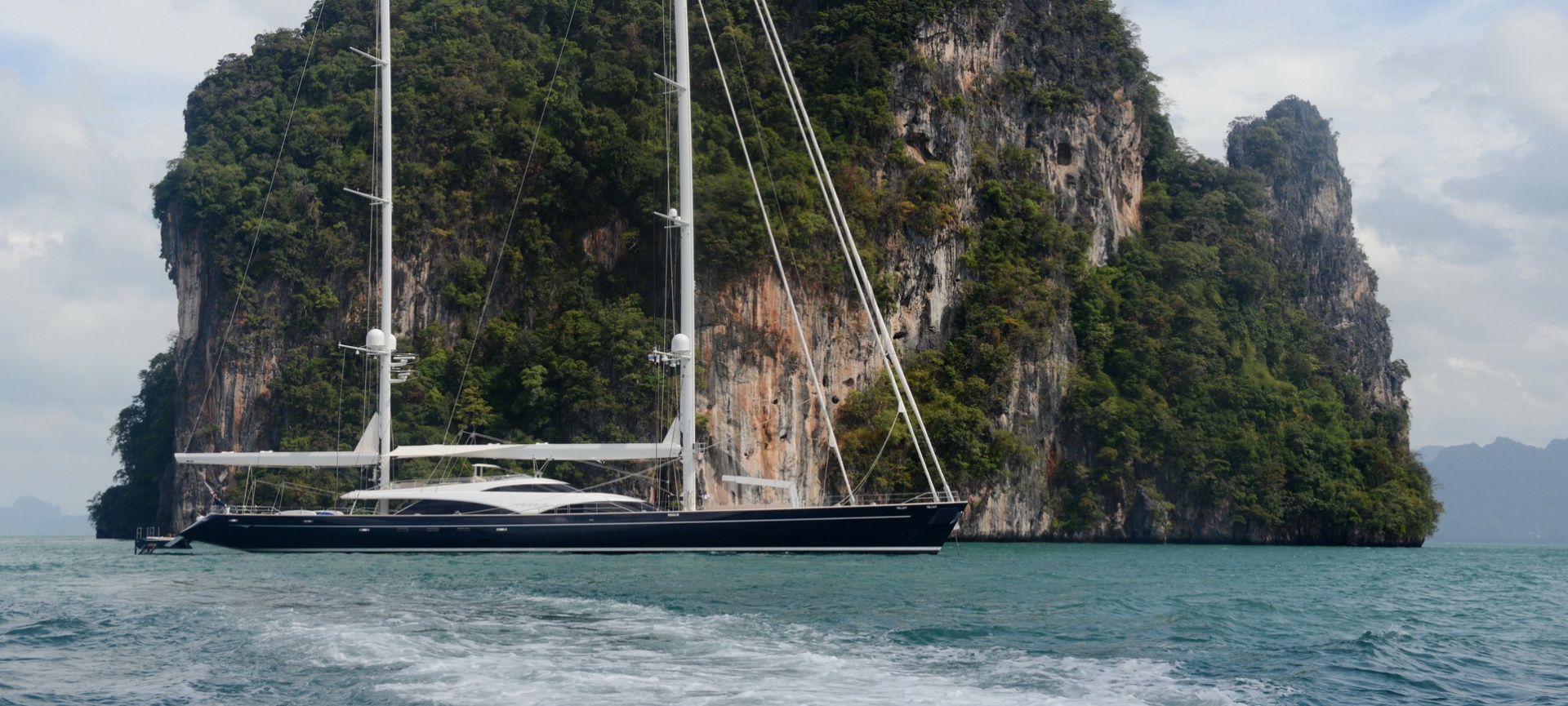
The owner of Twizzle and his family put her ocean-going vocation to good use by embarking on a leisurely circumnavigation of the globe following delivery in 2010. Based for much of 2013 in Phuket, Thailand, Twizzle spent the year cruising the Far East from the Andaman Islands to the Galapagos. Along the way, the yacht visited the remote Mergui Archipelago in southern Myanmar. Only recently opened up to foreign tourism, the region’s isolation from modern influences has lent the islands and surrounding waters a huge diversity of flora and fauna, and ensured that its stunning rainforest and underwater habitats have remained intact.
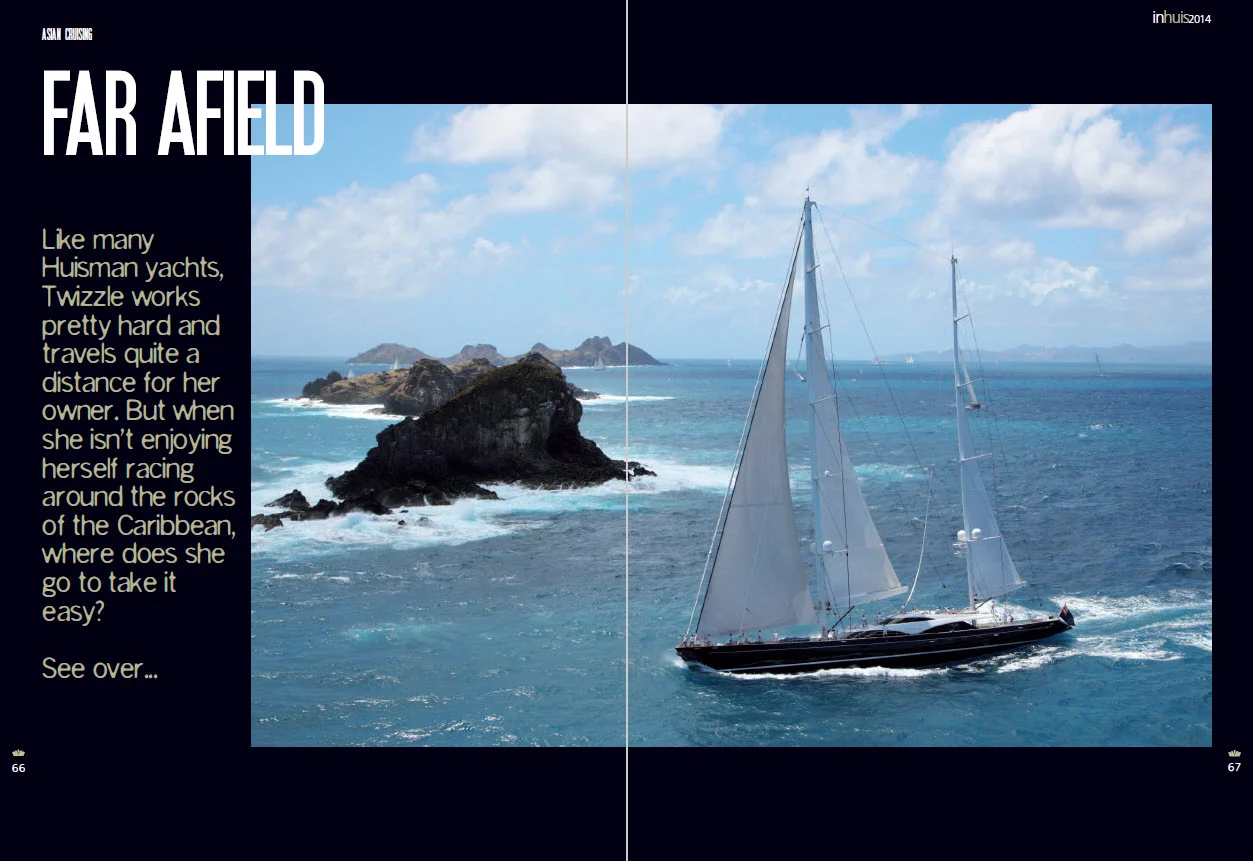
Here the owner of Twizzle describes, in his own words, the highlights of the cruise.
“Even though it is just 110 nautical miles north of the hustle and bustle of Phuket, the virtually uninhabited Mergui Archipelago stands out as one of the most outstanding and unspoilt of all. Comprising some 800 stunning islands spread out over 14,000 square miles, with countless rocks and pinnacles and uncluttered anchorages in one of the most unpolluted waters in the world, it is a yachtsman’s and diver’s dream.
It was only in 1996 that the first dive boats were allowed in from Thailand, and even then just a couple each year. The last two years have seen huge political changes in Myanmar, but these changes and mass tourism and commercialism seem to have bypassed this sleepy and most southerly province. And still just a handful of yachts are granted access, ostensibly as dive boats, although the process is now much easier.
After sampling the exquisite if somewhat busy waters of the Similan Islands near the Thai-Myanmar border, we headed off to Myanmar itself and the southern port of Kawthaung. This part of Myanmar seems to have been left untouched since it opened up following decades of sanctions and embargo. There are no cars and even the Chinese buses are straight out of the old Mao Tse-Tung era. The streets of ramshackle houses in bamboo and wood are teeming with bicycles, rickshaws and scooters. Every woman and child has paste on their cheeks to protect them from the sun and life centres on the market with its tiny stalls of rice, vegetables, cooking pots and farmers’ produce.
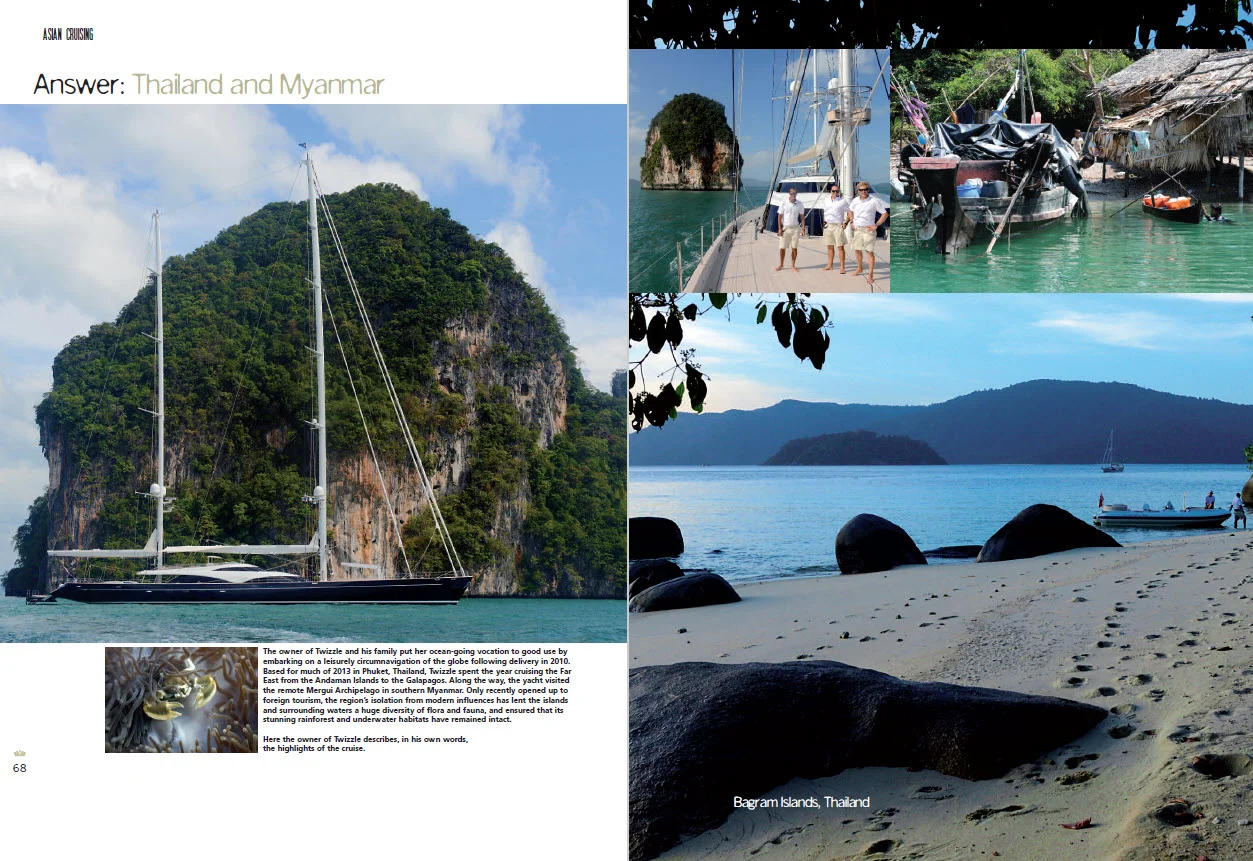
We headed out around 3pm to find a suitable overnight anchorage. What we actually found was the most awe-inspiring collection of largely uninhabited limestone islands, pinnacles and bays in the bluest water we have ever encountered. We ended up at the most gorgeous anchorage on Horseshoe Island surrounded by towering rocks, a rainforest and a palmfringed beach and lagoon of the softest white sand, with a couple of fisherman’s huts to add local colour. Chattering macaque monkeys came down to the beach at dusk to hunt for crabs. Needless to say, the sunset was so staggering – replete with a green flash – we felt at that point it was just showing off.
We spent the next couple of days exploring the magnificent islands nearby with their superb bays and rock formations. Copula is one giant collapsed cave, which can only be entered at low tide through a gap at the base of a cliff. It is home to a family who live in a house built on bamboo stilts and collect birds’ nests found on the cliffs for soup. Macleod Island with its rainforest and fabulous snorkelling, and Cavern Island with its limestone cathedral-like caves, and Stewart Island, were just superb. Lord Loughborough Island has a scenic fjord running deep into the island that proved to be a wonderful overnight anchorage. The diving was wonderful with forests of fans and soft corals in every colour. Beds of anemones cover boulders as far as the eye can see and the reefs are filled with crustaceans and tropical fish of every variety and hue. It is mostly pinnacle and rock diving on the ocean side where the water is clearer and deeper.
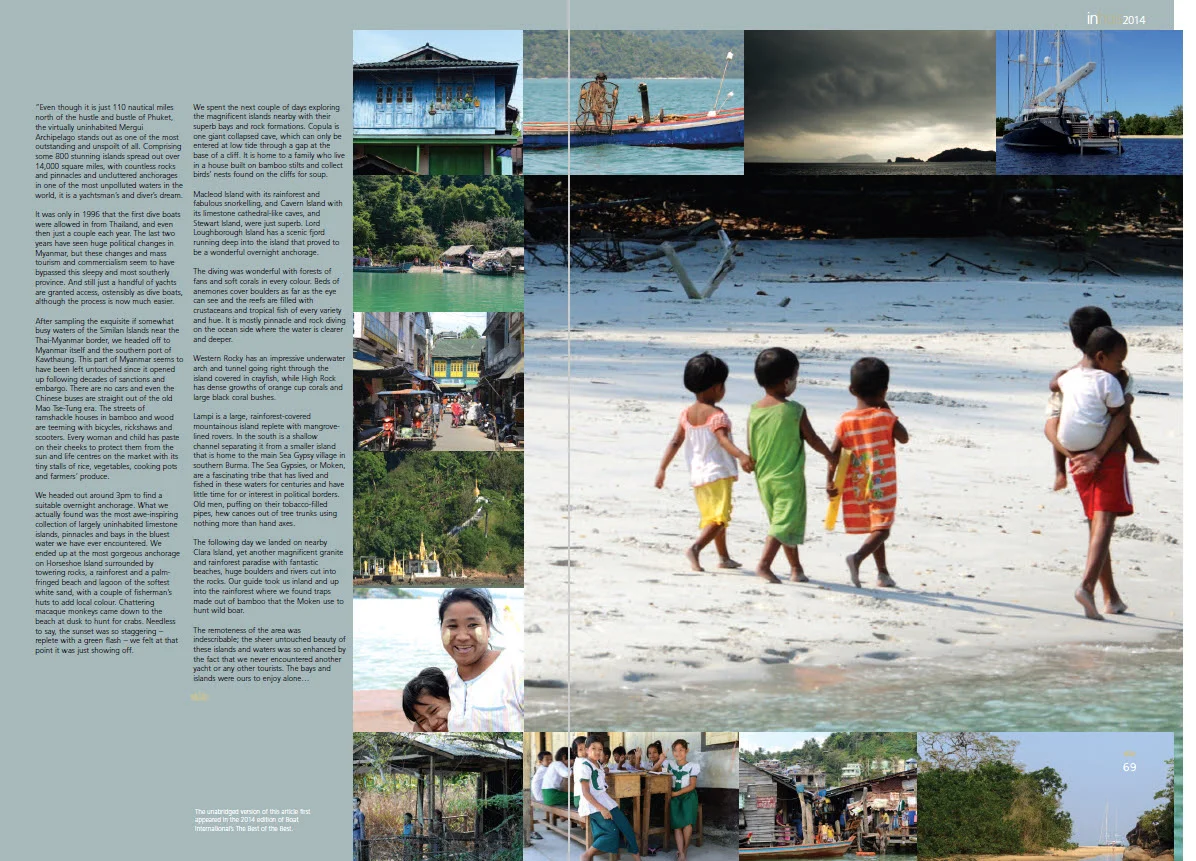
Western Rocky has an impressive underwater arch and tunnel going right through the island covered in crayfish, while High Rock has dense growths of orange cup corals and large black coral bushes. Lampi is a large, rainforest-covered mountainous island replete with mangrovelined rovers. In the south is a shallow channel separating it from a smaller island that is home to the main Sea Gypsy village in southern Burma. The Sea Gypsies, or Moken, are a fascinating tribe that has lived and fished in these waters for centuries and have little time for or interest in political borders. Old men, puffing on their tobacco-filled pipes, hew canoes out of tree trunks using nothing more than hand axes.
The following day we landed on nearby Clara Island, yet another magnificent granite and rainforest paradise with fantastic beaches, huge boulders and rivers cut into the rocks. Our guide took us inland and up into the rainforest where we found traps made out of bamboo that the Moken use to hunt wild boar.
The remoteness of the area was indescribable; the sheer untouched beauty of these islands and waters was so enhanced by the fact that we never encountered another yacht or any other tourists. The bays and islands were ours to enjoy alone…
This article was published in INHUIS fall / winter 2014 - 2015. The unabridged version first appeared in the 2014 edition of Boat International’s The Best of the Best.
Learn more about Twizzle? yachts > delivered yachts


